
Compassion Fatigue Strategies
Psst, it's not just about compassion fatigue (it's so much more than that).
A unique course for animal care, protection, and welfare professionals who want to make sense of what they're experiencing and figure out how to do this work sustainably.
8 weeks • 100% online • 5 live calls • 15 CE credits
Starts October 26th | Cost: $250
Early Bird: $175 through October 18thwith code CFS2026
Register Now!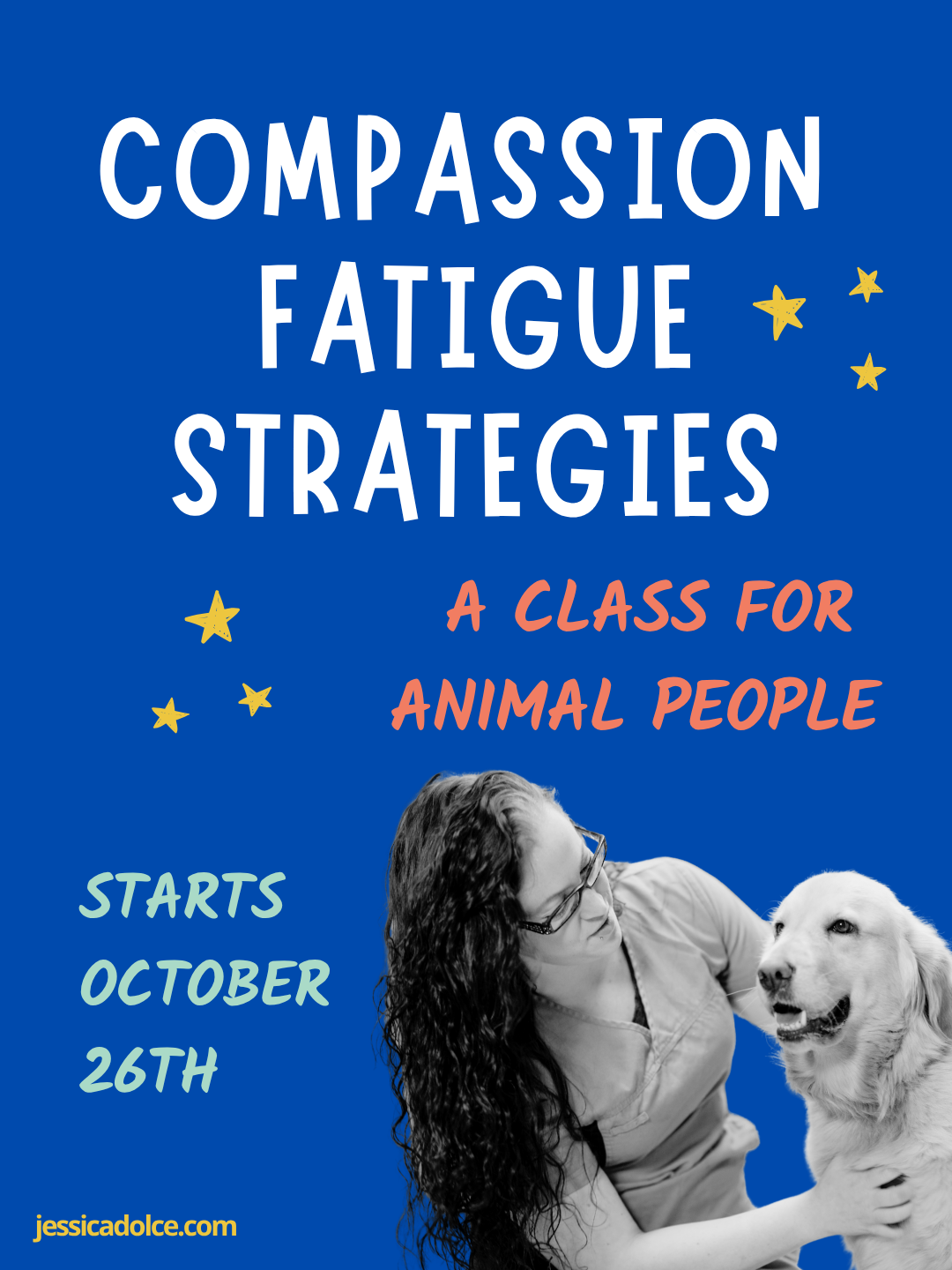
You love this work. But it's taking a serious toll.
When you care deeply about animals and people, the demands of the job can pile up fast. There's empathic distress, grief, burnout, moral distress, trauma exposure, impossible decisions, desperate situations, and no matter how hard you work, there's always more to do.
Sometimes we call all of that "compassion fatigue."
It's a useful shorthand, but reality is more complex than that.
Understanding what's actually happening matters because different kinds of stress call for different responses. That's where we'll start.
10 years. More than a thousand animal care professionals. One freshly updated course.
I originally developed Compassion Fatigue Strategies for the University of Florida Shelter Medicine program, where I taught it from 2014–2024.
Now I'm bringing an updated version directly to you with everything I've learned from nearly 15 years of supporting animal welfare professionals through occupational stress and 25 years working and volunteering in our field.
Join me starting on October 26th for a truly unique course specifically designed to support animal welfare, care, and protection professionals that you can take at your own pace and schedule.
We get together for 5 (optional) live calls (that will be recorded) to practice stress reduction and mindfulness techniques. It's five hours of self-care, built right into the class. Plus, we talk about what we’re experiencing on the discussion boards and learn from each other. You won't be doing this by yourself, but you don't have to be in class at specific times.
“I really appreciated this course and learned a lot of new ways in which to help myself navigate some of the more difficult aspects of my job….
I feel like I'm back in control of my work life...
and it’s easier now to remember why I do what I do and focus on the good parts…I feel so much more well-equipped to handle the emotional roller coaster now that I’ve taken your course.”
– Amber L., Stranding Biologist, 2022 CFS alum
By the End of Class You’ll:
-
Understand the many forms of occupational stress that can show up in helping work, including compassion fatigue, burnout, grief, moral distress, and empathic strain, and recognize how they may affect you.
-
Recognize your own warning signs of stress and learn how to track them so you can respond to your needs in real time, rather than waiting until you're completely depleted.
-
Build a personal toolkit of practical, evidence-informed strategies. You'll experiment with different approaches to recovery, stress management, social support, self-care, mindfulness, self-compassion, boundaries, narratives, and self-regulation practices to figure out what works for you.
- Identify what helps you navigate the emotional demands of your work, cope with guilt, grief, and other difficult feelings.
- Make small, realistic changes in your life that support a sustainable approach to doing the work. Things like: tweaks to your boundaries, relationships, daily routines, technology, mindset, and expectations.
-
Reconnect with what matters to you and the joy of helping. You'll lean into your values and make intentional choices so you can experience more satisfaction, meaning, purpose, and empathic delight!
-
Turn insights into doable actions to support your peers, volunteers, or staff. Because we really need each other, and what you learn in this class can help others!
-
Refocus your energy on what you can control and learn to cope with what you can't. Identify where your limited resources are best spent.
-
Figure out if and when additional support may be needed and understand how to seek professional mental health care without shame or stigma.

“I’m not the kind of person to readily discuss my feelings. I’m the kind of person who loves my job and wants to get my work done and do it well. I’ve gotten to the point in my career that I know this is an industry where I could work myself past the point of no return, whether that be burning out or leaving animal welfare entirely.
I came to this work because I love it. I just needed to figure out how to do it sustainably.
Jessica Dolce’s CFS class was recommended to me by a friend in the field and has been a great source of information, discussion, and...
The feeling you get when you realize you’re not alone.
The work we do is insurmountable. It’s never-ending. Sometimes it’s thankless. Sometimes it’s hard to remember why we started doing it in the first place. This course is approachable and self-paced. I am a terrible procrastinator, but I got it done, and I’m glad I did.”
– Shelter Medicine Veterinary Assistant, 2017 CFS alum
Class Overview:
1. Recognize changes: What is happening to me?!: We'll unpack compassion fatigue, burnout, moral distress, grief, trauma exposure, empathic strain, and the other forms of occupational stress that can come with helping work.
2. Understand, manage, and regulate stress: Learn to recognize your "stress signature," aka patterns and warning signs, and figure out what your stress is actually telling you.
3. Recover from work with practical self-care. Experiment with strategies for recovery, boundaries, self-care, mindfulness, self-compassion, social support, and stress management.
4. Refocus on your why: Reconnect with compassion satisfaction, meaning, values, empathic joy, and the parts of this work that feel good.
5. Restore your capacity: Develop core resilience skills that can help you cope when the work gets hard.
6. Make it sustainable with small repeatable actions: Turn what you've learned into doable changes. You'll identify the strategies, habits, routines, boundaries, and sources of support that fit your life, and create a realistic plan for putting them into practice without adding another impossible list of things you "should" be doing.
7. Relate with respect and spread the care: Learn practical ways to support your coworkers and staff, share what you're learning, and start noticing how your organization's policies and practices affect the people doing the work.

I LOVED this course!! It went so deep into the science of stress and trauma, which helps when trying to understand your own and others' feelings. I loved how we practiced different methods of stress management.
I now have so many tools in my toolbox to deal with stress, trauma, burnout, and compassion fatigue.
The class taught tangible ways to work through things and to recharge, and other reflective ways to help ourselves and others. Jessica was an awesome teacher; she is warm, kind, and funny! I recommend this class to all shelter staff and volunteers!
– Carrie, Volunteer Manager, 2024 CFS alum
Here’s What You’ll Get:
You’ll have multiple ways to learn, reflect, practice, and connect.
-
8 weeks of guided learning
Work through eight core modules at your own pace, with short lessons, practical exercises, videos, reflection prompts, and resources you can return to for a year after the course ends. -
5 live group calls with Jessica
Join me for five live Zoom sessions where we’ll dig deeper into the course material, practice self-care strategies, and connect the dots between what you’re learning and what’s happening in your real life. -
Private course discussions
Connect with other animal care, protection, and welfare professionals who understand the realities of this work. Ask questions, share experiences, and learn from one another throughout the course. Discussion boards will be open and facilitated by Jessica for 8 weeks (Oct. 26 - Dec. 20, 2026). -
Practical tools and resources
Download a workbook designed to help you apply what you're learning after class ends. -
15 CE credits
Earn 15 continuing education credits upon successful completion of the course. -
One year of access
Take the course at a pace that works for you, and keep access to the course materials and resources for one year from the course start date. Jessica will be available for questions and support for the first 8 weeks of the course.

This course has done my soul so good. It has refreshed my own toolbox to keep doing the work I am called to do.
After 20 years in Animal Welfare/Sheltering, I have never had such a deep dive into my own experiences and coping skills. Really foundational for anyone doing this work!!
– Elizabeth, State-level Animal Welfare Inspector, 2022 CFS alum
This class is for you if...
- You love this work but sometimes wonder how sustainable it is.
- You want to understand what's actually happening, so you can explain your experiences to yourself, friends, family, colleagues, or your therapist
- You want practical strategies you can experiment with, so you can find what actually works for YOU.
- You know you need to take better care of yourself (even though you also know that self-care alone isn't the answer).
- You’re a supervisor, manager, or director who wants help supporting the people you lead.
- You want to bring what you learn back to your team for peer support.
- You work or volunteer with or for (any species of) animals in shelters, rescues, sanctuaries, clinics, investigations, legislation, etc.
This class is not for you if...
- You’re looking for a quick fix. This is gonna take more than creatine.
- You need mental health treatment or support for a current crisis. This course is educational and is not a substitute for professional medical care.
- You want someone to tell you exactly which self-care practices you should be doing. I'm not selling supplements or meditation apps.
- You want a course that focuses only on individual self-care and ignores workplace and organizational factors.
- You’re not interested in reflecting on your own patterns, habits, boundaries, and responses to stress.
- You’re looking for training designed for your whole organization, or ready-to-use tools for training and supporting your team. That's what The Compassion in Balance Program is for!

“The class was wonderful. Not only did I love the content, but I loved Jessica's down-to-earth style.
It felt like I was learning from a friend.
This class helped me to understand all aspects of compassion fatigue better and gave me the tools to share with others. Take this class!
– Gina, Volunteer + Outreach Coordinator, CFS alum
Two Ways to Pay


2 Monthly Payments: $125
Use this option to make 2 monthly payments of $125.
FAQs
How do I enroll a group?
Do I have to attend the live calls?
How long will I have access?
Is this therapy?
Are there CEUs?
How is the class delivered? What do I need to have?
Is this just about self-care?
What if I'm not experiencing compassion fatigue?

“I had recently accepted my dream job as a shelter veterinarian, and I wanted to prepare myself to enjoy this job through retirement. Jessica’s course had everything I needed: well-organized and informative educational lessons, calls that guided me through meditation and relaxation practices to use in my daily life, and online interaction with other animal welfare workers who faced the same struggles and setbacks I did.
I can now help my colleagues identify and counteract the emotional spiral that can overtake us in times of crisis.
I’ve been given valuable tools to use when I’m struggling with my own emotions in this difficult field.
I’m so glad I found this course. I've recommended it to everyone in my organization...It’s a course that should be required of all veterinarians, veterinary nurses, and shelter administrators.”
– Jessica S. DVM, 2017 CFS alum
This class helped me understand that it is not a sign of failure or weakness to stop, say no, and care for yourself.
– Dr. R, veterinarian, 2015 CFS alum

I've been in animal welfare 25+ years and listened to many webinars and read
about compassion fatigue. This class helped give me a greater understanding of what actual compassion fatigue is and other concepts related to it.
It has helped me gather a great set of tools and resources not only for myself but for my staff that I lead that I didn't have before. It also helped me evaluate as a leader things I need to pay more
attention to in helping both the individual and organization succeed as much as possible.
I believe it has and will continue to make me a better leader.
– Laura, Director of Animal Care, 2022 CFS alum
